
Arabic Letter Chart
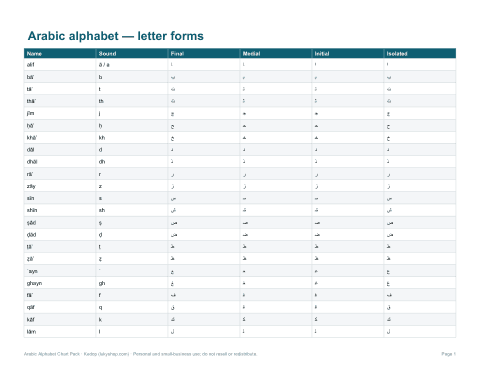
Arabic is written from right to left in a flowing script where most letters join to their neighbours and change shape depending on their position in a word. This printable pack sets out all 28 letters with their four forms — isolated, initial, medial and final — plus names and sounds, so learners can recognise letters wherever they appear.
- Instant download
- Print-ready PDF
- 7-day refund
5 files · PDF
Arabic Alphabet Chart Pack
Printable Arabic alphabet chart with all four letter forms, tracing sheets for 28 letters, flashcards, a letter families and non-joining letters reference and a vowel marks chart.
- Alphabet chart (PDF)
- Flashcards (PDF)
- Letter families (PDF)
- + 2 more
$5.00 USD, one-time 5 files · about $1.00 each
- Instant download
- 7-day refund
- Secure checkout by Stripe
7-day money-back guarantee. Full refund within 7 days of purchase, even after you download.
Free sample: Arabic Alphabet Forms (PDF, 111 KB)
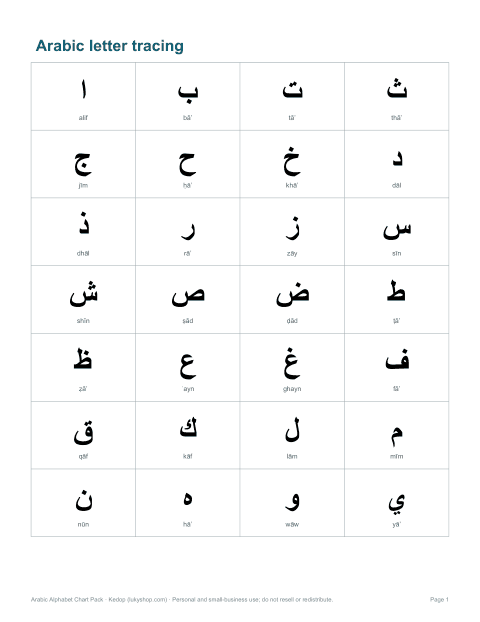
Arabic Alphabet Chart Pack
Printable Arabic alphabet chart with all four letter forms, tracing sheets for 28 letters, flashcards, a letter families and non-joining letters reference and a vowel marks chart.
- Alphabet chart (PDF)
- Flashcards (PDF)
- Letter families (PDF)
- Vowel marks (PDF)
- Tracing sheets (PDF)
Formats: PDF. Instant download after payment (link valid 72 hours, up to 5 downloads). AI-assisted: the templates were drafted with AI help and reviewed and laid out before publishing.
$5.00 USD, one-time 5 files · about $1.00 each
- Instant download
- 7-day refund
- Secure checkout by Stripe
7-day money-back guarantee. Full refund within 7 days of purchase, even after you download.
Free sample: Arabic Alphabet Forms (PDF, 111 KB)
Full refund within 7 days — see the refund policy and license.
Free printables
Single sheets you can print right now, no sign-up. The full pack adds every sheet in one download plus the editable files.
 Printable Arabic Alphabet Chart
 Printable Arabic Letter Flashcards
 Printable Arabic Letter Families Chart
 Printable Arabic Vowel Marks Chart
 Printable Arabic Letter Tracing Sheet
The Arabic alphabet with letter forms
| Letter | Name | Sound | Final | Medial | Initial | Isolated |
|---|---|---|---|---|---|---|
| ا | alif | ā / a | ﺎ | ﺎ | ﺍ | ﺍ |
| ب | bāʼ | b | ﺐ | ﺒ | ﺑ | ﺏ |
| ت | tāʼ | t | ﺖ | ﺘ | ﺗ | ﺕ |
| ث | thāʼ | th | ﺚ | ﺜ | ﺛ | ﺙ |
| ج | jīm | j | ﺞ | ﺠ | ﺟ | ﺝ |
| ح | ḥāʼ | ḥ | ﺢ | ﺤ | ﺣ | ﺡ |
| خ | khāʼ | kh | ﺦ | ﺨ | ﺧ | ﺥ |
| د | dāl | d | ﺪ | ﺪ | ﺩ | ﺩ |
| ذ | dhāl | dh | ﺬ | ﺬ | ﺫ | ﺫ |
| ر | rāʼ | r | ﺮ | ﺮ | ﺭ | ﺭ |
| ز | zāy | z | ﺰ | ﺰ | ﺯ | ﺯ |
| س | sīn | s | ﺲ | ﺴ | ﺳ | ﺱ |
| ش | shīn | sh | ﺶ | ﺸ | ﺷ | ﺵ |
| ص | ṣād | ṣ | ﺺ | ﺼ | ﺻ | ﺹ |
| ض | ḍād | ḍ | ﺾ | ﻀ | ﺿ | ﺽ |
| ط | ṭāʼ | ṭ | ﻂ | ﻄ | ﻃ | ﻁ |
| ظ | ẓāʼ | ẓ | ﻆ | ﻈ | ﻇ | ﻅ |
| ع | ʿayn | ʿ | ﻊ | ﻌ | ﻋ | ﻉ |
| غ | ghayn | gh | ﻎ | ﻐ | ﻏ | ﻍ |
| ف | fāʼ | f | ﻒ | ﻔ | ﻓ | ﻑ |
| ق | qāf | q | ﻖ | ﻘ | ﻗ | ﻕ |
| ك | kāf | k | ﻚ | ﻜ | ﻛ | ﻙ |
| ل | lām | l | ﻞ | ﻠ | ﻟ | ﻝ |
| م | mīm | m | ﻢ | ﻤ | ﻣ | ﻡ |
| ن | nūn | n | ﻦ | ﻨ | ﻧ | ﻥ |
| ه | hāʼ | h | ﻪ | ﻬ | ﻫ | ﻩ |
| و | wāw | w / ū | ﻮ | ﻮ | ﻭ | ﻭ |
| ي | yāʼ | y / ī | ﻲ | ﻴ | ﻳ | ﻱ |
Read the forms from right to left, as Arabic is written. Transliteration follows a common academic style; dots under letters mark sounds that don’t exist in English, such as ḥ (a breathy h from the throat) and ṣ, ḍ, ṭ, ẓ (heavier “emphatic” consonants).
Letters that don’t join forwards
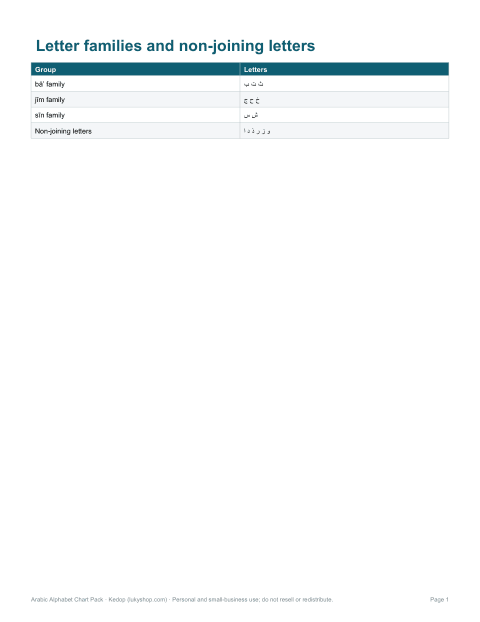
Six letters — alif ا, dāl د, dhāl ذ, rāʼ ر, zāy ز and wāw و — join to the letter before them but never to the letter after. That means the next letter in the word starts again with an initial or isolated form. Learning these six early makes reading much easier, because they explain the small gaps you see inside words.
Letter families
| Family (same base shape) | Letters | How to tell them apart |
|---|---|---|
| bāʼ family | ب ت ث | 1 dot below, 2 dots above, 3 dots above |
| jīm family | ج ح خ | Dot below, no dot, dot above |
| dāl family | د ذ | No dot, one dot above |
| rāʼ family | ر ز | No dot, one dot above |
| sīn family | س ش | No dots, three dots above |
| ṣād family | ص ض | No dot, one dot above |
| ṭāʼ family | ط ظ | No dot, one dot above |
| ʿayn family | ع غ | No dot, one dot above |
| fāʼ and qāf | ف ق | One dot above, two dots above |
Many letters share a basic shape and differ only in their dots — learning them as families halves the work.
How to practise
- Learn the isolated forms and names first.
- Trace each letter on the tracing sheets, following the stroke direction from right to left.
- Practise the four forms of one letter family at a time.
- Read short joined words, noticing where non-joining letters break the word.
- Use the flashcards daily for a few minutes.
Short vowels and other marks
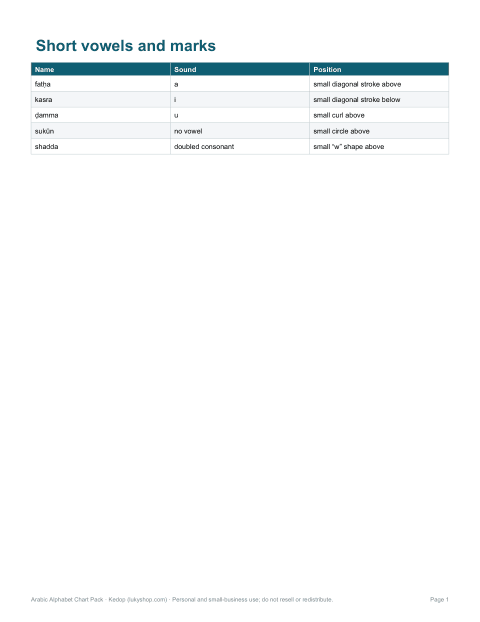
Arabic letters are consonants and long vowels. Short vowels are shown by small marks above or below letters — fatḥa (a), kasra (i) and ḍamma (u) — along with sukūn (no vowel) and shadda (a doubled consonant). These marks are used in the Qurʼan, children’s books and learning materials, but usually omitted in newspapers and everyday writing.
What’s in the pack
- Alphabet chart with all four forms (PDF poster).
- Letter tracing sheets for all 28 letters.
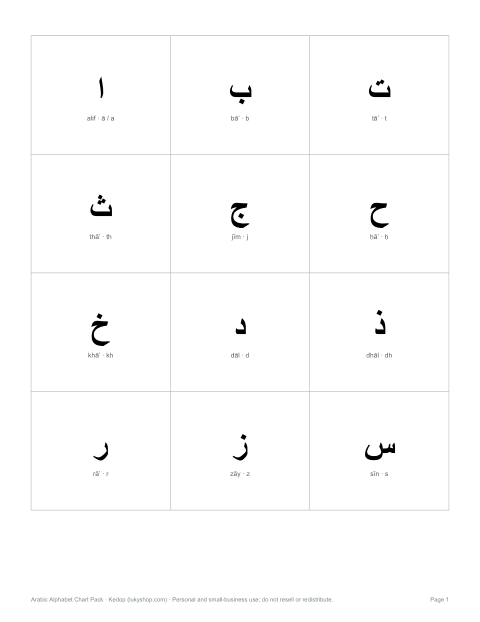
- Flashcards with the letter, name and sound.
- Non-joining letters and letter families reference.
- Vowel marks chart.
Formats and printing
All pages print on US Letter or A4. The tracing sheets work well in sheet protectors with a dry-wipe pen for repeated practice.
AI-assisted content
Charts were compiled with AI assistance and reviewed before publishing against standard Modern Standard Arabic references. Pronunciation varies across dialects.
Frequently asked questions
How many letters are in the Arabic alphabet?
28 letters.
Why do Arabic letters change shape?
Most letters join to their neighbours, so they have initial, medial, final and isolated forms.
Which Arabic letters don’t connect to the next letter?
Alif, dāl, dhāl, rāʼ, zāy and wāw.
Which way is Arabic written?
From right to left.
Are short vowels included?
Yes, a vowel marks chart is in the pack.
Is this a subscription?
No, it is a one-time download.